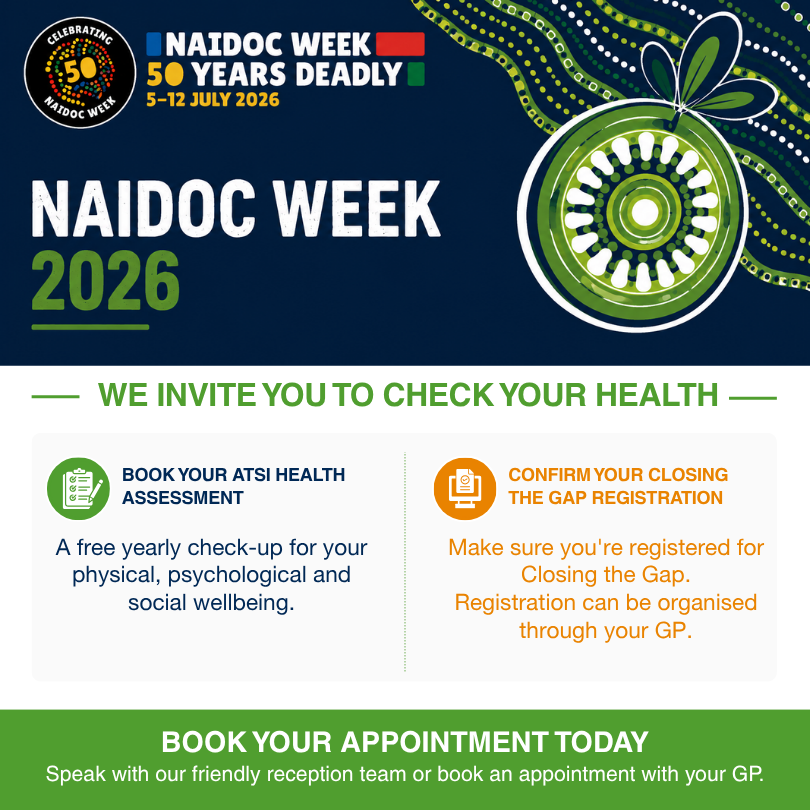
NAIDOC Week 2026 (5–12 July) is a time to celebrate the history, culture and achievements of Aboriginal and Torres Strait Islander peoples, the oldest continuing cultures in the world.
It’s also a good time to think about staying strong, for yourself, your family, your Elders, your mob and your Country. Looking after your health is one part of that.
A health check isn’t a test you pass or fail. It’s simply a way of staying well enough to keep doing the things and being there for the people that matter most.
What the 715 health check is
The Aboriginal and Torres Strait Islander health check, which you might hear called the “715”, after its Medicare item number, is a free, yearly check built around the health needs of Aboriginal and Torres Strait Islander people.[1]
It’s not a rushed five minutes. It usually takes under an hour, and it’s as much a yarn as a check-up:
• A conversation first. How you’ve been feeling, anything that’s been worrying you, your family’s health history, and how life’s going day to day: sleep, food, staying active, stress.
• A physical check. Things like blood pressure and weight, and sometimes blood tests, with everything explained as we go.
• A plan, together. We go through what we found in plain language and work out a few realistic next steps that actually fit your life.
The Australian Institute of Health and Welfare (AIHW) notes these checks are designed to pick up conditions that affect Aboriginal and Torres Strait Islander people more often, like diabetes, heart disease and mental health concerns, so they can be found and managed early.[2]
Why catching things early matters
Some of the conditions that show up most often: diabetes, heart and blood vessel disease, and kidney issues, can be quiet in the early stages. You can feel completely well even as something slowly builds up. By the time you notice it, it can be harder to turn around.[3]
When found early, those same conditions are usually far easier to manage, which means more good years doing the things you love with the people you love.
And yet a lot of people miss out. AIHW figures show only around 1 in 4 Aboriginal and Torres Strait Islander people had a health check in 2024.[4] A check isn’t about being sick, and it isn’t about being judged. It’s a normal part of looking after yourself, the same way you’d look out for family.
Health is more than the body
We recognise that for many Aboriginal and Torres Strait Islander people, being healthy isn’t just about the body; it’s about being connected: to family, to community, to culture and to Country. The AIHW reflects this too, describing good health as a holistic concept that encompasses social, emotional, cultural and spiritual wellbeing for the individual and the community alike, not just the absence of illness.[5] A good health check makes room for all of that.
That’s also why who you yarn with matters. A check done by people who take the time to understand your community, your mob and where you come from, is one you’re far more likely to feel comfortable with.
What it costs
If you identify as an Aboriginal or Torres Strait Islander person and have a Medicare card, the check is free at any Aboriginal Medical Service or bulk-billing clinic, and you’re eligible for one every year.
Feeling unsure about going?
That’s normal, and you’re not alone in it. A couple of honest things worth knowing:
If you’re worried about what they might find, finding something early is good news, because it means there’s time to do something about it. You won’t be left to deal with it on your own.
If you already live with a condition like diabetes or heart disease, that’s exactly when these checks help most, making sure the right support is around you.
You can bring someone with you. You can ask as many questions as you like. And you can take it at your own pace.
What happens afterwards
You’ll leave knowing where your health is at right now, anything worth keeping an eye on, and a few clear next steps, whether that’s a follow-up, a referral, or simply staying in touch with your GP.
The check isn’t a one-off. Many people go on to see a dietitian, physio or podiatrist as part of their plan, also available through Medicare for eligible Aboriginal and Torres Strait Islander people. In fact, more than half (53%) of people who had a health check in 2024 went on to receive a follow-up or chronic disease management service within six months.[6] Having a GP who knows your story and walks alongside you over time is one of the most useful things there is for staying well.
This NAIDOC Week
Looking after yourself is part of celebrating who you are and where you come from. When you’re strong, your family and your community are stronger too.
If it’s been a while or you’ve never had one, you’re welcome to come in for a yarn and a check whenever you’re ready.
This article is for general information only and is not medical advice. We recommend you speak with your GP for advice specific to you.
[1]Australian Government Department of Health, Disability and Ageing, Annual health checks for Aboriginal and Torres Strait Islander people. https://www.health.gov.au/topics/aboriginal-and-torres-strait-islander-health/primary-care/annual-health-checks
[2]Australian Institute of Health and Welfare (2025), Health checks and follow-ups for Aboriginal and Torres Strait Islander people — Trends and insights (last updated 21 October 2025). https://www.aihw.gov.au/reports/indigenous-australians/indigenous-health-checks-follow-ups/contents/trends-and-insights
[3]General Practice Supervision Australia (GPSA), Teaching Plan: Aboriginal and Torres Strait Islander health assessment. https://gpsa.org.au/our-resources/supervision-support/aboriginal-and-torres-strait-islander-health-assessments-teaching-plan/
[4]Australian Institute of Health and Welfare (2025), Health checks and follow-ups for Aboriginal and Torres Strait Islander people — Trends and insights. Health check uptake plateaued at 25% (266,000 participants) in 2024. https://www.aihw.gov.au/reports/indigenous-australians/indigenous-health-checks-follow-ups/contents/trends-and-insights
[5]Australian Institute of Health and Welfare (2025), Health checks and follow-ups for Aboriginal and Torres Strait Islander people — Benefits of health checks. https://www.aihw.gov.au/reports/indigenous-australians/indigenous-health-checks-follow-ups/contents/benefits-of-health-checks
[6]Australian Institute of Health and Welfare (2025), Health checks and follow-ups for Aboriginal and Torres Strait Islander people — Trends and insights. Of those who had a health check in 2024, 53% received a follow-up or chronic disease management service within six months. https://www.aihw.gov.au/reports/indigenous-australians/indigenous-health-checks-follow-ups/contents/trends-and-insights Note: 2024 follow-up figures are preliminary, based on health check participants from January to June 2024.
